

Part 3: Lifecycle Architecture
Designing Organizations Around the Full Arc of Human Contribution with the Human Org OS

Estimated Read Time: 12-13 minutes

Imagine a senior leader, eight years into their tenure, carrying relationships and institutional knowledge no new hire could replicate in several years. They have a second child and ask for a reduced schedule. The employer has no structure for it, so they exit. The organization posts the role, spends six months searching, and onboards someone who will spend the next two years catching up to where they already were.
This happens every day in organizations still running on an industrial-era employment model designed for work that was physical and repetitive, not relational, cognitive, and judgment-dependent. The predictable variations that define a human life are often treated as disruptions to manage. Lifecycle architecture is the discipline of designing organizations around a different premise entirely.
This essay is part of the Human Org OS, a proprietary framework for designing organizations as living systems, creating the structural conditions in which human contribution and organizational performance sustain each other over time. The framework consists of six architectural pillars:
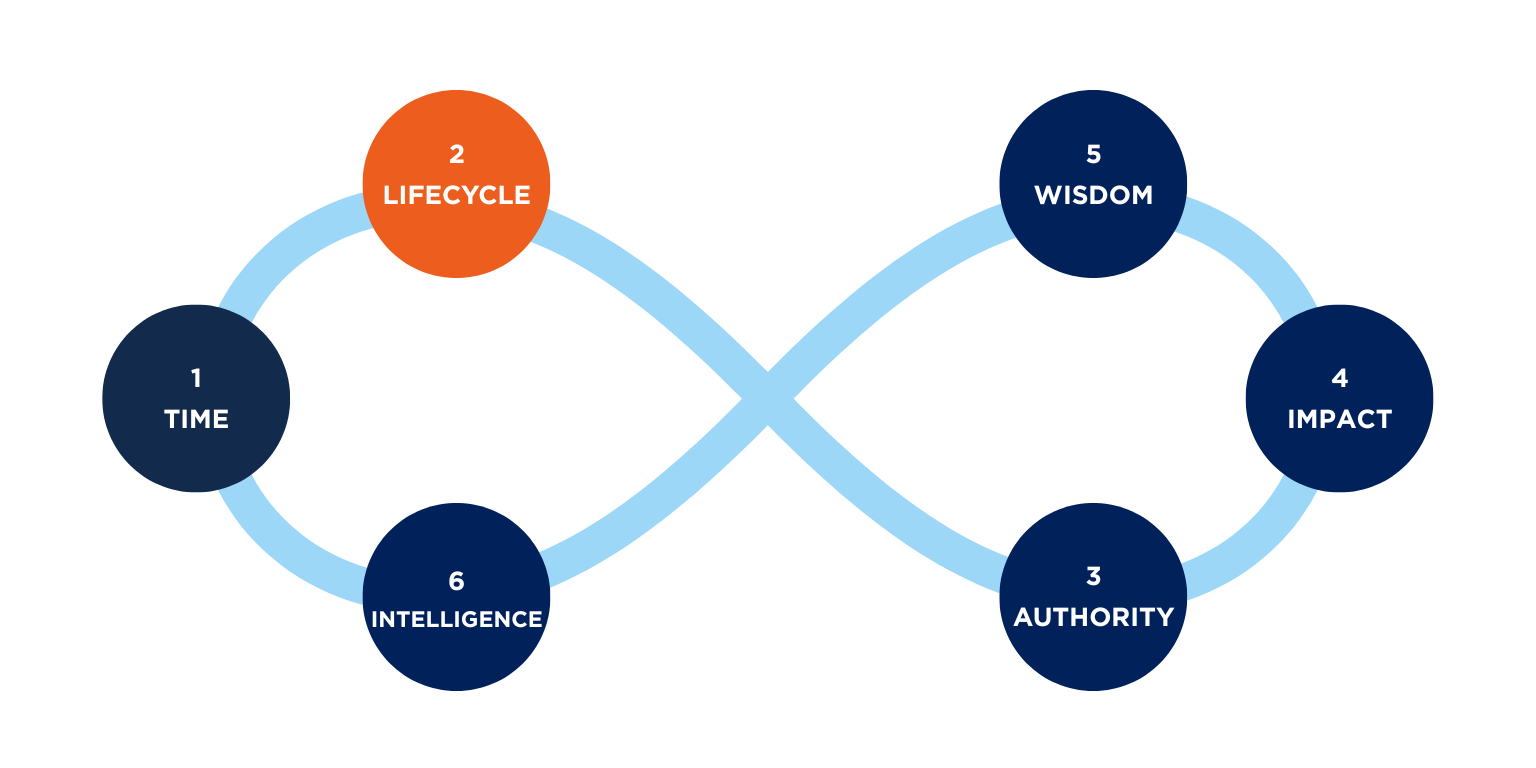
This essay focuses on the second pillar, Lifecycle Architecture.
The principles explored here are especially relevant for organizations at seed or Series A stage, where the informal accommodations that worked in a small team no longer hold. Without intentional lifecycle design, organizations begin losing talent at precisely the moments when that talent has become most valuable: when employees have accumulated years of institutional knowledge, built deep relationships, and developed the judgment that only experience produces.
The lifecycle architecture outlined in this essay focuses on five core design levers:
Life-phase mapping
Life-phase elasticity
Senior part-time and fractional roles
Caregiving infrastructure
Re-entry protocols
Organizations designed to support the full arc of human contribution do not compromise on performance. They outperform those that do not.
The Business Case for Intentional Lifecycle Architecture
Talent loss at life-phase transitions is one of the most significant and least examined costs in organizational design. The industrial-era employment model was built for a workforce that moved in a straight line: hired young, trained, utilized and retired. That model never reflected how human contribution actually works, and it is increasingly costly to maintain.
Research cited in Harvard Business School’s Healthy Outcomes report estimates the cost of replacing an employee at anywhere from 33 to 200 percent of their annual salary, with that figure rising two to four times higher for senior roles, and excludes the hidden costs of lost institutional knowledge, degraded client relationships, and the drag on co-worker productivity (Fuller, 2024). These costs compound at every predictable life-phase transition an organization fails to design for.
The losses occur across the full career arc. Early-career contributors leave when development investment is absent and progression pathways are unclear. Mid-career contributors at peak institutional value exit during care-intensive years when structural flexibility does not exist. Later-career contributors disengage or depart entirely when organizations have no pathway for them to contribute at reduced intensity without stepping off the ladder. Each of these exits is predictable and preventable.
Caregiving transitions represent the most visible and documented category of lifecycle-driven talent loss. Research found that 32 percent of all employees have voluntarily left a job at some point due to caregiving responsibilities, with departure rates highest among the most experienced (Fuller, 2024). Some of those exits reflect a genuine personal choice. The problem is that many do not. When contributors who want to remain professionally engaged are forced out because no structural accommodation exists, organizations lose institutional knowledge and judgment that cannot be quickly replaced, and individuals lose career continuity they may never fully recover.
What makes this particularly costly is that most business leaders do not recognize it is happening. Lifecycle exits are consistently misread as personal decisions: someone wanted more time with family, wasn’t the right fit, or simply moved while the structural conditions that made staying untenable go unnamed and unexamined. Organizations that treat predictable exits as purely individual choices never build the architecture to prevent them.
For mission-driven organizations, these losses carry additional weight. Building a team deeply aligned with a restorative mission takes years. The founders and early contributors who understand why the work matters are not easily replaced. Culture, values, coherence, and stakeholder trust are embedded in people. When those people leave unnecessarily, the organization does not just lose capacity. It loses integrity. Organizations that design proactively for lifecycle continuity retain what they have invested in building, and become as conscious of human life as the solutions they are building.
The 5 Design Levers of Lifecycle Architecture
1. Life-Phase Mapping
The first step in lifecycle design is acknowledging what most organizations quietly ignore. The simple fact that human contribution is not uniform across a career. The way a person engages with work at 27 is structurally different from how they engage at 42, and different again at 58. These are not variations in work ethic. They are variations in life context, cognitive orientation, relational capacity, and available energy. Organizations that treat all phases as equivalent consistently lose talent at predictable transition points, often while believing the departures were unpredictable or personal.
Across a career, contributors typically move through several distinct phases:
Early-career employees bring energy, adaptability, and motivation to establish themselves, but they require significant investment in development, mentorship, and structural guidance.
Mid-career contributors often represent the highest return on organizational investment. They carry institutional knowledge, established relationships, and the judgment that comes from years of navigating complexity.
Care-intensive years introduce competing demands typically during peak contribution years that linear structures consistently fail to accommodate.
Later-career contributors bring perspective, pattern recognition, and organizational wisdom that cannot be replicated quickly by any hire.
Each phase carries distinct strengths, constraints, and requirements for organizational support. Life-phase mapping is the practice of explicitly identifying these phases within your workforce, understanding where each contributor currently sits, and designing structures that leverage the strengths of each phase rather than penalizing contributors for not being in a different one.
This does not require invasive personal inquiry or discrimination. It requires structural awareness. A high-performing senior leader who requests a reduced schedule during a care-intensive season is not declining in value. They are navigating a predictable life transition that, with modest structural accommodation, need not interrupt organizational contribution at all.
It is worth noting that the demographic pressure on care-intensive years is only intensifying. The U.S. Census Bureau projects that by the 2030s, the number of people 65 and older will outnumber those under 18 for the first time in American history, directly expanding the sandwich generation of working adults simultaneously caring for children and aging parents. The contributors most capable of leaving when that load becomes unsustainable are typically the ones with the most external options. Harvard Business School research confirms this: senior leaders and executives leave due to caregiving demands at nearly 50 percent, compared to an overall workforce rate of 32 percent (Fuller, 2024). Designing flexibility into the organization before a crisis point is not an accommodation. It is a retention strategy.
2. Life-Phase Elasticity
Life-phase elasticity is the organizational capacity to flex role configurations in response to life-phase transitions without penalizing the contributor or degrading organizational performance. Most organizations operate on a rigid binary employment model: full-time or part-time, senior or junior, in or out. These binaries create false choices that cost organizations significant talent at inflection points across the entire career arc.
The penalty structure embedded in many employment models operates the same way regardless of why a contributor needs to flex. A senior leader who requests reduced scope to care for a newborn, support an aging parent, manage a health transition, or complete a professional reinvestment faces the same structural problem: the organization has no designed pathway for contribution at a different intensity. The default response is demotion, exclusion from strategic conversations, or quiet removal from advancement consideration. High performers read this accurately and leave.
Life-phase elasticity means building role configurations that can contract and expand in response to life circumstances without requiring contributors to exit the organizational ladder entirely. A senior contributor might carry 60 to 80 percent of a standard scope during a constrained season while retaining title, compensation commensurate with scope, and continued access to the strategic conversations and client relationships built over years. Explicit agreements around reduced scope should include a clear definition of what the modified role contains and a clear pathway back to full scope when circumstances allow.
Organizations that design this flexibility in advance, rather than negotiating it individually when a contributor reaches a crisis point, send a precise signal: contribution is measured by the quality of judgment and the depth of relationships, not by the number of hours available in a given season.
3. Senior Part-Time and Fractional Roles
The assumption that senior expertise requires full-time presence is one of the most expensive myths in organizational design. It routinely forces organizations to choose between accessing high-quality judgment and managing the cost of that judgment. It forces senior contributors to choose between full engagement and any other life priority. Neither choice is optimal, and neither is necessary.
Senior part-time and fractional roles decouple expertise from constant availability. They allow organizations to access the strategic judgment of experienced leaders without requiring those leaders to occupy every meeting, every decision, and every operational moment. They allow senior contributors to sustain meaningful professional engagement across life phases that full-time employment would make impossible.
The growth of fractional executive roles confirms that this model works at the highest levels of organizational complexity. Executive positions explicitly mentioning fractional arrangements more than tripled since 2018, with CFO and CMO functions leading adoption (Revelio Labs, 2025).Organizations that have adopted fractional leadership structures report that the quality of strategic input does not diminish when it is not tied to daily presence. In many cases, the fractional executive’s perspective is sharper precisely because this person is not consumed by operational noise.
For scaling organizations in the 15 to 150 employee range, fractional roles are a particularly well-suited structural tool. At this stage, the organization needs senior judgment it cannot yet afford to carry full-time. A fractional Chief People Officer, a fractional CFO, or a senior advisor in a defined functional domain can provide exactly the strategic guidance required during an inflection point without the full cost of a permanent hire.
Knowledge-intensive organizations are particularly vulnerable to talent loss because competitive advantage resides in people rather than in physical assets (Coff, 1997). Fractional and part-time structures are one of the most readily available tools for retaining access to knowledge assets that would otherwise exit entirely.
What makes this model credible at scale is the fact that other economies have already institutionalized it. The Netherlands offers the most instructive global example. Under the Flexible Working Act (Wet Flexibel Werken), which came into effect in 2016, employees who have been with an employer for 26 weeks or more have a legal right to request reduced hours, and employers must accommodate the request unless there is a substantial business reason not to (Dutch Flexible Working Act, 2016).
Approximately 38.6 percent of the Dutch workforce works part-time as of 2024, the highest proportion in the EU (Eurostat, 2024). The structural career penalty that makes reduced-hour arrangements feel risky in the United States is significantly lower in the Dutch system, and the Dutch economy has not suffered for it. Productivity per hour worked in the Netherlands consistently exceeds the OECD average (OECD, 2024). The lesson is not that the United States should replicate Dutch labor law. It is that the assumption tying senior contribution to full-time presence is a cultural artifact, not an economic necessity, and organizations willing to challenge it have a structural advantage in retaining experienced talent others will continue to lose.
Designing fractional and senior part-time roles well requires clarity on three elements: scope, access, and rhythm.
Scope defines what the role is responsible for and what it explicitly is not.
Access defines when and how the fractional contributor engages with the organization, specifically which meetings, which decision points, and which communication channels.
Rhythm defines the cadence of engagement so that the contributor can plan around it and the organization can count on it.
Without these three elements defined explicitly, fractional arrangements drift toward either underutilization or informal full-time expectations, neither of which serves the organization or the contributor.
4. Caregiving Infrastructure
Caregiving is not an exceptional edge case in the modern workforce. It is one of the most predictable and universal life-phase demands that employees face. Most smaller organizations in the United States treat it as a series of individual HR exceptions. Organizations designed for the post-industrial era need to treat it as infrastructure.
Patagonia has operated an on-site childcare program since 1983, reporting 100 percent of mothers returning to work after maternity leave over a five-year period, and a turnover rate for parents with children in the program running 25 percent lower than the general employee population (Marcario, 2016).
Harvard Business School modeling across 97 companies found that organizations offering caregiving support can expect ROI of 225 to 340 percent when employee replacement costs are conservatively estimated at 50 percent of salary, with returns rising sharply for senior roles where replacement costs are higher. The analysis found companies need only reduce turnover by 1.67 percentage points to break even on their caregiving benefit investment (Fuller, 2024). The investment is not philanthropic. It produces a measurable return, and the return compounds over time as retained employees accumulate institutional knowledge and sustained client relationships that new hires cannot replicate quickly.
Few organizations will have the scale or context to replicate Patagonia’s on-site model. But the underlying principle is applicable at any scale. Identify the caregiving demands that are predictable across your workforce and design organizational systems that accommodate them rather than requiring employees to absorb the cost individually.
Caregiving infrastructure includes several categories of design:
Flexible scheduling that aligns with school calendars and care routines is the most broadly applicable.
Parental leave policies that are genuinely normalized, meaning that taking leave does not result in visible career penalties, are a prerequisite for retention among contributors in family-formation years.
Emergency caregiving provisions allow employees to respond to acute care demands without depleting personal time off or concealing the need from their employer.
Manager training is essential throughout as a caregiver-friendly policy that managers implement inconsistently provides employees no reliable structure to plan around.
For founders building organizations from the ground up, the window to design caregiving infrastructure intentionally is now, before hiring creates path dependencies and before a retention crisis forces reactive policy-making. The cost of building this infrastructure proactively is a fraction of the cost of the talent loss it prevents.
5. Re-Entry Protocols
Re-entry protocols are formal organizational pathways for contributors returning to active engagement after a life-phase departure. Most organizations do not have them. The absence of a structured re-entry process is one of the most significant sources of talent underutilization in the modern workforce, affecting professionals who have paused careers for caregiving, health transitions, entrepreneurial ventures, advanced education, or any other reason that pulled them outside conventional employment for a defined period.
A contributor who stepped away from a senior role does not lose their expertise during that time. The judgment, relational capacity, and systems thinking developed over years of professional contribution remain intact. What changes is familiarity with current tools, team dynamics, and organizational context. These are orientation gaps, not competency gaps, and they are entirely bridgeable with modest structural investment.
Without formal re-entry structures, returning contributors are forced to negotiate their own return from a position of perceived weakness, typically accepting roles and compensation well below their actual capability level. Organizations that allow this lose the value they would have gained from a structured return, and they reinforce the very penalty structure that drove the contributor out in the first place.
Several major organizations have formalized this insight into structured returnship programs. Goldman Sachs pioneered the concept in 2008 and continues to run one of the most established programs in financial services. IBM’s Tech Re-Entry program places returning professionals in roles matched to their prior expertise. Unilever has developed similar infrastructure across its global operations. The fact that organizations of this scale have invested in formal re-entry architecture is itself instructive: experienced contributors who are given a structured pathway back do not need to be convinced to perform. They need to be given the conditions to do so.
A well-designed re-entry protocol includes several components:
Explicit organizational commitment. Returning contributors are welcomed at a role level commensurate with their prior experience, with title and compensation reflecting their actual capability, not the gap on their resume.
Structured 90-day orientation. The first three months focus on rebuilding organizational context, tool familiarity, and team relationships rather than immediate full-scope performance expectations.
A dedicated context guide. The returning contributor is paired with a current colleague whose role is to orient, not evaluate, providing insider context that accelerates reintegration without the pressure of performance oversight.
Milestone conversations at 30, 60, and 90 days. Structured check-ins assess how the return is progressing and address any gaps before they compound, giving both the contributor and the organization a clear view of the transition.
For mission-driven organizations, re-entry infrastructure is a particularly underutilized talent strategy. The pool of experienced contributors who have stepped away from organizational roles and are now available to return is substantial. They often carry values alignment, perspective, judgment, and motivation directly relevant to the work restorative technology companies are doing. Building formal re-entry infrastructure is a direct investment in accessing that pool at a fraction of the cost of sourcing equivalent expertise from the open market.
Considerations
Lifecycle architecture is not without implementation complexity. Organizations that have operated on rigid employment models for years will find that introducing structural elasticity requires active management of equity perceptions. When one employee receives a modified scope arrangement and another does not, the difference must be explainable in terms that colleagues understand as fair. Without that clarity, well-designed lifecycle policies can inadvertently generate resentment rather than reduce it.
The solution is not to make lifecycle accommodations invisible or individually negotiated. It is to make them structural and transparent. When the organization publishes clear criteria for when and how scope flexibility is available, and when those criteria apply consistently, the perception of favoritism dissolves. What remains is an organizational norm that communicates to all contributors: this is an organization designed to sustain your career, not extract from it.
It is also worth acknowledging that lifecycle architecture introduces coordination complexity, particularly in client-facing roles where consistency of contact matters. Organizations need to design for this explicitly rather than allowing coordination to fall informally to the contributor operating at reduced scope. Fractional and reduced-scope arrangements work best when the organizational system, not the individual, absorbs the coordination requirements.
Designing Organizations That Sustain Human Contribution
The cost of designing organizations as if their contributors exist outside of predictable human life phases is not abstract. It shows up in the early-career contributor who leaves after two years because no development pathway was visible. It shows up in the senior leader at peak institutional value who exits because no reduced-scope arrangement existed when she needed one. It shows up in the later-career executive whose judgment and pattern recognition walk out the door entirely because no fractional or advisory role was ever designed to retain them. These are not individual decisions. They are structural failures, and they are preventable.
Lifecycle architecture is the discipline of designing organizations that can sustain meaningful contribution across the full arc of a human career. It is not a departure from organizational rigor. It is a more complete form of it.
Organizations built this way are more resilient, more capable of accessing the full range of human talent available to them, and more aligned with the values that drew their people to mission-driven work in the first place. They are also better positioned to endure, because organizations that sustain the humans who build them are organizations built to last.
The goal is not a perfect lifecycle policy. It is an organization that a person of judgment and integrity, at any stage of their career, would be proud to build their professional life within. Most scaling organizations are nowhere near this. They are losing their most experienced contributors at precisely the moments when that experience becomes most valuable, and treating the exits as inevitable rather than designed.
If this framework is relevant to what you are building, let’s talk: jessica@anointedarchitects.com
Sources
Coff, R. W. (1997). Human assets and management dilemmas: Coping with hazards on the road to resource-based theory. Academy of Management Review, 22(2), 374–402.
Dutch Flexible Working Act (Wet Flexibel Werken). (2016). Government of the Netherlands.
Eurostat. (2024). Part-time and full-time employment statistics. European Commission.
Fuller, J. (January 2024). Healthy Outcomes: How employers’ support for employees with caregiving responsibilities can benefit the organization. Harvard Business School.
Marcario, R. (2016). Why should employers care about families? Patagonia Stories.
OECD. (2024). OECD Compendium of Productivity Indicators 2024. OECD Publishing.
Revelio Labs. (2025). Everyone needs a side hustle these days — even executives.