

Part 2: Time Architecture
Designing Organizational Time with the Human Org OS

Estimated Read Time: 7-8 minutes

Imagine a founding team three years into building something significant. The product works and the first real funding round just closed. The executive team is capable and aligned. And then, quietly, the organization starts slowing down. Decisions that used to take a week now take three. The CEO is in six hours of meetings before noon. The head of product has not had an uninterrupted morning in four months. No one quit or failed. The calendar simply filled up, and the cognitive infrastructure required to lead a scaling company got buried underneath it.
This happens in nearly every organization that grows past thirty people without intentional time design, and the reason is structural, not personal. The standard workday was not designed around human performance. It was designed to keep machines running during the Industrial Revolution. Two centuries later, most organizations still operate on that logic, optimizing for presence and availability rather than for the cognitive capacity that knowledge work actually requires. Yet the human body is a complex biological system with limits, recovery needs, and optimal operating conditions. No engineer would expect a machine to run continuously without calibration. Organizations that apply the same systems thinking to human performance consistently produce higher quality output, sustained over time, not less of it.
Time Architecture is the discipline of designing organizations around that premise.
This essay is part of the Human Org OS, a proprietary framework for designing organizations as living systems, creating the structural conditions in which human contribution and organizational performance sustain each other over time. The framework consists of six architectural pillars:
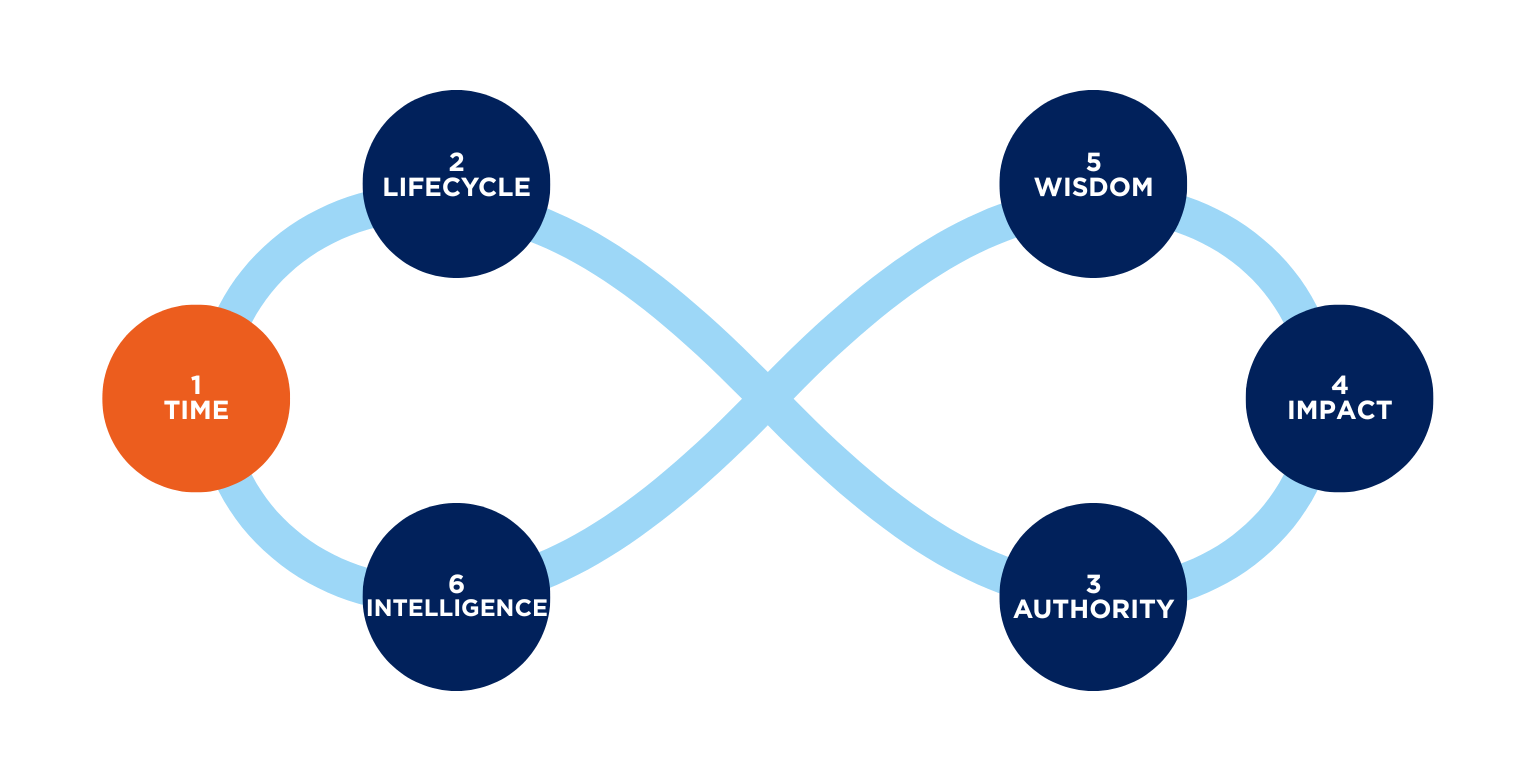
This essay focuses on the first pillar, Time Architecture.
Many of its principles support other pillars such as lifecycle, wisdom and impact. Subsequent essays explore these pillars in greater depth. If you want an introduction of the structural problems underlying modern work systems, these are explored in the first essay of the series, Part 1: Leading Beyond Linear Work: How traditional structures undermine human-centered organizations.
The ideas that follow are especially relevant for organizations at the seed or Series A stage, where coordination complexity increases faster than most founders anticipate. Rather than adding layers of process, organizations can intentionally design how time functions so focus, decision-making, and recovery remain protected as the company grows.
The time architecture outlined in this essay focuses on six core design levers:
Cognitive capacity
Deep work protection
Communication cadence
Cycle-based work
Recovery infrastructure
Seasonal planning
The Business Case for Intentional Time Architecture
As organizations scale from small, tightly coordinated teams to more complex structures, coordination overhead grows exponentially. Meetings multiply, leadership bandwidth is stretched thin, and critical decisions bottleneck as executives are pulled into reactive management. Research shows that employees spend up to 21% of their time in meetings, much of it unproductive, representing a significant hidden cost in salary dollars (Waber, Magnolfi, & Lindsay, 2014). Productivity suffers not from lack of effort, but from misaligned structures that fragment focus and impede flow. Redesigning organizational time can be a strategic lever to sustain speed, decision quality, and capacity during growth.
For mission-driven organizations, these challenges carry additional stakes. Limited capital, high burnout risk, and employees motivated primarily by purpose make operational misalignment particularly costly. Employee turnover due to burnout can exceed 20–30% annually in high-demand roles, with replacement costs averaging 1–1.5x salary per lost employee (Huselid, 1995; Cascio, 2006). Intentional time design protects mission integrity, supports sustainable performance for high-value contributors, and preserves institutional knowledge. When applied consistently, human-centered time structures enable teams to deliver on their mission without sacrificing their capacity or risking critical talent loss.
The 6 Design Levers of Time Architecture
1. Cognitive Capacity
Human cognitive output is a finite resource. It is not constant across a day, week, or year. It peaks, dips, and recovers in patterns that are broadly predictable. Research on knowledge work shows that high-quality analytical thinking rarely exceeds four to six hours per day. Beyond that window, attention, working memory, and decision quality begin to decline.
Research by K. Anders Ericsson found that top performers in cognitively demanding fields typically engage in no more than four to five hours of intensive mental work per day, usually broken into multiple sessions with recovery between them (Ericsson, Krampe, & Tesch-Römer, 1993). Additional hours are generally spent on lower-intensity tasks such as communication, administration, or preparation.
Despite these limits, most organizations still design the workday as if cognitive performance were constant across eight or more hours. A more realistic structure places high-value thinking during predictable cognitive peaks, typically in the morning and a shorter window later in the afternoon. In Rest: Why You Get More Done When You Work Less, Alex Soojung-Kim Pang shows that many highly productive thinkers organized their days around two or three concentrated work sessions separated by substantial breaks. Workdays designed around these rhythms typically include:
Two or three protected focus blocks of 90–120 minutes
Midday recovery periods that allow cognitive reset before a second work cycle (exercise and exposure to light increase the impact of recovery breaks)
Communication and meetings clustered outside primary focus windows
In practice, this structure often resembles a school-day model where the most demanding thinking occurs within a six-hour window. Some organizations shorten the core workday, while others maintain eight hours but separate deep work from reactive collaboration. Aligning high-cognitive work within a six-hour window can also reduce personal conflicts for working parents by allowing lower-intensity tasks to occur around school pickup and drop-off times.
When organizations treat cognitive capacity as a design constraint rather than an individual discipline problem, work becomes more potent and sustainable leading to greater consistency and predictability rather than the peaks and crashes so prevalent in startup culture.
2. Deep Work Protection
Context switching is devastating to focus and with our increasingly connected world, concentration can feel impossible to come by. Deep work or uninterrupted, high-focus time is critical for problem-solving and innovation and yet, many organizations make little effort to protect this time. Of course, individuals can turn their notifications off, but if workplace culture doesn’t support deep work, people often don’t feel safe carving that space out for themselves.
Research by Gloria Mark at the University of California, Irvine found that after an interruption, knowledge workers require an average of 23 minutes and 15 seconds to fully return to the original task (Mark, Gudith, & Klocke, 2008). Transitions between tasks cumulatively erode hours of productive time each week. This is especially the case for cognitively demanding tasks.
Ways to protect this time are many; 2–3 hour daily meeting-free blocks, designated no-meeting days, caps on weekly meeting hours, and default asynchronous communication. Structuring calendars to protect deep work allows employees to produce higher-quality outcomes and reduces the fragmentation caused by constant interruptions.
In one engineering organization I worked with, this issue became significant enough that the team advocated for a solution they called “Focus Fridays,” a dedicated day each week for uninterrupted work without meetings or the expectation of speedy Slack responses. This gave engineers space for deep planning, coding, and execution without continuous context switching. After the change, both employee satisfaction and productivity improved.
3. Communication Cadence
Constant reactive communication fragments attention and drains cognitive energy. Research cited in Harvard Business Review and Microsoft’s Work Trend Index shows that knowledge workers now spend roughly 57% of their work time in meetings, email, or chat, leaving only 43% for focused work (Microsoft, 2023).
Organizations that redesign communication structures around intentional meeting culture and asynchronous updates can reclaim large portions of this lost focus time. By shifting to weekly strategic updates instead of daily reactive check-ins, instituting quarterly narrative resets to align teams on priorities, and establishing a healthy meeting culture, businesses can preserve deep-work capacity, lower cognitive fragmentation, achieve faster decision clarity, and scale more easily across distributed teams.
Designating defined decision owners and pre-defined escalation pathways is an important tactic for protecting communication channels and reducing fire drills. This practice keeps execution speed steady, reduces duplicated work and improves cross-functional clarity.
While Zoom fatigue is a very real thing, communication overload rarely originates from a single tool. It typically emerges when escalation pathways and decision ownership are unclear. Once clear decision owners and structured update rhythms are introduced, the volume of reactive communication tends to drop quickly because teams no longer rely on constant status checking to maintain alignment.
4. Cycle-Based Work
Rather than sustaining continuous project flow as most U.S. organizations do, work can be structured into clearly defined cycles of intensity followed by integration. Typical models include 6–8 week focused execution sprints followed by 1–2 week cooldown periods for reflection, documentation, and strategic recalibration. Avoiding scheduling major launches back-to-back prevents burnout and cognitive overload.
This rhythm allows teams to operate at peak performance during high-intensity periods while preserving recovery and increasing creativity in low-intensity intervals. An added benefit is that work is timeboxed within the constraints of the sprint leading to sharper decisions and strong output. Instead of extracting the maximum output possible from employees without regard for longevity, this model supports optimal performance windows while acknowledging the need for integration in order to sustain long-term performance.
Basecamp operates on six-week work cycles followed by two-week cooldown periods, during which no new projects are assigned. This allows teams to decompress, reflect, and decide what to tackle next. In summer months, the workweek drops to 32 hours. Basecamp frames these choices not as perks, but as performance infrastructure. They argue that fewer hours in reactive mode means more hours in creative and strategic mode. Their full approach is publicly documented in their employee handbook.The result is a company that has remained profitable and low-turnover for decades without venture funding or growth-at-all-costs pressure.
5. Recovery Infrastructure
A common pattern in knowledge organizations is immediate task replacement after delivery, where a new project lands as soon as the previous one is completed. Recovery should be an embedded part of operational design rather than treated solely as something to be done during allotted vacation time. Organizations can implement post-launch decompression weeks as previously mentioned, but they can also implement mandatory minimum vacation usage policies, meeting-light weeks each quarter, and rotating on-call schedules to prevent chronic overload. By systematically integrating recovery into workflows, organizations safeguard mental and physical health, maintain sustained performance, and reduce turnover.
The most widely cited structural intervention is the four-day workweek. A six-month four-day workweek pilot involving 61 UK companies and nearly 3,000 employees, conducted by researchers from Boston College and the University of Cambridge, found that employee burnout dropped by 71% and staff turnover declined by 57%. Stress levels also fell by 39%, while company revenues remained stable or slightly increased during the trial period (Autonomy Institute, 2023). Some of Japan’s most well-known corporations, Panasonic and Hitachi, have voluntarily introduced four-day options, driven by data showing that overwork was degrading output quality rather than improving it.
An alternative to reducing to four days a week is to reduce the hours to 30-32, but spread them out over five days. This has the added benefit of aligning the work schedule to the school schedule for working parents and allowing customer facing teams to still be available five days a week. Leaders tend to initially assume reduced work hours will reduce output, whereas the opposite pattern often emerges. Teams can even produce higher quality work while reactive work and unnecessary meetings naturally decline.
6. Seasonal Planning
For most of human history, people lived according to seasonal needs and opportunities. Although modern organizations operate as if time is season-agnostic, human energy and capacity still fluctuate across the year. Workloads can be aligned with these rhythms by avoiding major strategic resets in low-energy periods such as late December or mid-summer, scheduling intensive planning cycles in higher-energy quarters, reducing meeting cadences during summer months, and aligning major deadlines with school-year rhythms for working parents. Matching work intensity to human capacity improves decision quality while reducing strain. Instead of ignoring seasonality, organizations benefit from planning alongside it.
In one European organization I worked with, the company effectively shut down during the winter holidays. Customers were largely offline and employees were encouraged to take time off collectively. Because the expectation was shared across the organization, work simply paused rather than continuing in a fragmented way. The company also offered unlimited vacation, allowing employees to self-govern time off. In practice, very few people abused the policy, and taking two weeks around the holidays carried no penalty.
Many American organizations follow the opposite pattern. Holiday time is typically deducted from limited PTO allowances, so employees often work through the holidays rather than use most of their leave at once. The result is fragmented collaboration, mediocre output, and scheduling inefficiencies as teams struggle to determine what work is actually productive in the final week of the year when half their team is offline. Much of this friction is avoidable with intentional seasonal planning and recognition that certain periods naturally call for a slower operational tempo.
Considerations
The design levers in this essay are not a checklist. They are interdependent architectural elements, and introducing them without leadership alignment or organizational readiness can produce the opposite of the intended effect. Protected focus time means nothing if managers schedule over it. Recovery cycles collapse under pressure if senior leaders model constant availability. The structural changes described here work when they are treated as operating commitments, not wellness experiments. Organizations that implement them selectively or inconsistently will see inconsistent results.
What Time Architecture Actually Produces
An organization with well-designed time architecture looks and feels different from the inside. Decisions move faster because the people responsible for making them are not perpetually fragmented. Senior leaders are doing their highest-value thinking during their highest-capacity hours. The team is not burning out in the second year of a build that requires a decade of sustained execution. Calendar creep has not quietly consumed the focus that strategic work requires.
Most scaling organizations are nowhere near this. They are running on reactive scheduling, undefined decision ownership, and the unspoken assumption that more hours equal more output. The evidence is clear that this assumption is wrong, and the organizations that correct it earliest will carry a structural advantage into the complexity that scale brings.
If you are preparing to scale and recognize the patterns described in this essay, the time to design your time architecture is before growth amplifies the gaps, not after. I work with founders building restorative technologies to design exactly this kind of organizational infrastructure. If this interests you, let’s talk: jessica@anointedarchitects.com.
Sources
Autonomy Institute. (2023). The results are in: The UK’s four-day week pilot. Autonomy Research Ltd.
Ericsson, K. A., Krampe, R. T., & Tesch-Römer, C. (1993). The role of deliberate practice in the acquisition of expert performance. Psychological Review, 100(3), 363–406.
Huselid, M. A. (1995). The impact of human resource management practices on turnover, productivity, and corporate financial performance. Academy of Management Journal, 38(3), 635–672.
Mark, G., Gudith, D., & Klocke, U. (2008). The cost of interrupted work: More speed and stress. Proceedings of the SIGCHI Conference on Human Factors in Computing Systems, 107–110.
Microsoft. (2023). Work Trend Index: Annual report on the state of work. Microsoft Corporation.
Pang, A. S.-K. (2016). Rest: Why You Get More Done When You Work Less. New York: Basic Books.
Waber, B., Magnolfi, J., & Lindsay, G. (2014). Workspaces that move people. Harvard Business Review, 92(10), 68–77.